Legal AI · Tort Law · State Common Law

The first hour of
every case, automated.

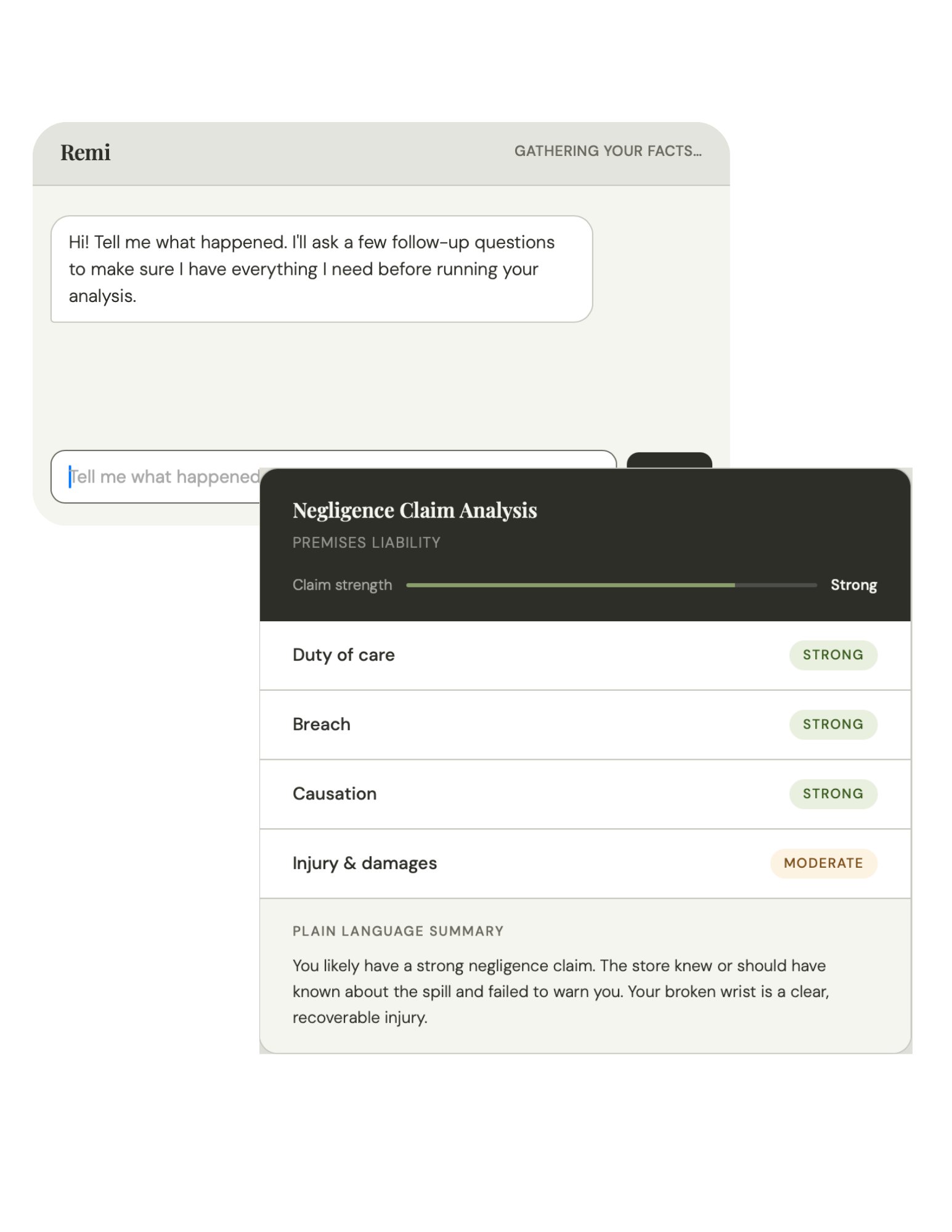
Remi automates tort claim intake analysis. We replace the fact-gathering process and attorney hours spent quality-checking cases with a full legal reasoning pipeline that runs in a few minutes.

Remi hero
Negligence Claim Analysis
Premises Liability
Claim strength
Strong
Duty of care Strong
Breach Strong
Causation Strong
Injury & damages Moderate
Plain language summary
You likely have a strong negligence claim. The store knew or should have known about the spill and failed to warn you. Your broken wrist is a clear, recoverable injury.
"Existing tools process documents. Remi processes doctrine. That is the unsolved problem and the distinction that matters."
— The Remi team
The problem

Knowing whether to start a case
takes hours of work.

Intake specialists handle screening calls and collect facts.

Evaluating whether that case is worth pursuing currently requires an attorney. It involves recalling doctrine, applying it to new facts, and reaching a qualified conclusion on duty, breach, causation, injury, and defenses. Every intake. Every time. Remi automates both layers.

Not a document processor
Existing legal AI tools retrieve and summarize documents. Remi applies doctrine to new facts, using the actual reasoning a lawyer performs, encoded as a structured pipeline.
Built for state common law
Most legal AI focuses on federal law and large firm work. State tort law is fragmented, jurisdiction-specific, and underrepresented. That is the gap Remi was built for.
Use cases
Plaintiff Firms
Automate the intake evaluation. Remi screens fact patterns, applies negligence doctrine to each element, and identifies the issues that matter. Spend time building cases, not screening them.
Primary market
Consumers
Consumers discover whether their case is worth pursuing instantly, with a full break-down of their case.
Access to justice
The broader opportunity
Tort intake is the foothold. The approach Remi uses applies to many other causes of action across state common law. Negligence is just a start.
Vision
Why now

Automating legal reasoning
is the unsolved problem.

The bar exam is a content test, a game of memorization. The real benchmark in law school is the issue spotter: given a messy fact pattern, identify every legal issue, apply doctrine to both sides, and reach a qualified conclusion on every element. That is what lawyers actually do.

Remi proves that AI can execute structured multi-step legal analysis reliably. The plaintiff tort market is underserved. Existing tools process documents, not doctrine.

Request early access
Not limited to negligence
The approach applies to any area of common law where doctrine can be encoded as a structured reasoning pipeline. Tort negligence is the prototype.
Roadmap
Currently in demo
Running live demos with law students from Columbia, NYU, and Duke. Analysis quality and intake workflow both confirmed. Ready for demos with injury law firms and pilots.
Today
Test & deploy
Five to ten paid pilots at solo and small plaintiff firms running live cases. Validate analysis quality against real attorney judgment. Identify the highest-value expansion points.
Next 90 days
The endpoint
A legal reasoning engine that produces memos, briefs, and complaints at the state level. We plan to scale horizontally across claim types and vertically by jurisdiction as the doctrine library grows.
Vision
Team

Founded by students from MIT and Columbia Law School.

Ready to see
Remi in action?

Join our waitlist and request a demo with Remi. We will respond as soon as possible.

Request early access